Nacl

本文最后更新于:2026年9月26日 下午

很高兴能在杭电新生赛出题,这也是我 ,感觉还不错。春季联赛还有一道我的题,敬请期待!其实新生赛已经结束很久,现在将题目公开在我的博客。

题目名字比较奇怪,因为当时某个人宣称 NaCl 是他的 npy,没有其他特别的意思。

提交链接:https://www.luogu.com.cn/problem/T544700

题目描述

小 y 喜欢在乐扣刷题,某一天做到了这样一个题

有一个长度为 \(n\) 的数组 \(a\),求出数组的所有子段和,并将这 \(\frac{n(n+1)}{2}\) 个数降序排列,他想知道第 \(k\) 个数有多大。

小 y 很快就解决了这个问题。但是小 y 觉得比起子段和,二元组的和更加美妙,比如 2Na(s)+Cl₂(g)→2NaCl(s),于是小 y 决定将子段和改成子段中最大值与最小值的和。

小 y 有一个长度为 \(n\) 的数组 \(a\),定义 \(\text{val}(l,r)=\min(a_l,a_{l+1},\dots,a_{r-1},a_r) + \max(a_l,a_{l+1},\dots,a_{r-1},a_r)\)。 小 y 想知道对于所有的 \(\text{val}(l,r),1\le l\le r\le n\),降序排列后,第 \(k\) 个数是多少,也就是第 \(k\) 大的 \(\text{val}\)。

输入格式

第一行一个正整数 \(T\) (\(T\le200\)) 表示数据组数。

对于每组数据:

第一行输入三个整数 \(n\) 和 \(k\),\((1\le n\le10^5,1\le k\le \frac{n(n+1)}{2})\) 分别表示数组长度,要求第多少大的 \(\text{val}\)。

第二行包含 \(n\) 个用空格分隔的整数,其中第 \(i\) 个数字表示 \(a_i\) 的值。 \((0\le a_i\le 10^9)\)

保证 \(\sum n=1064824\)

输出格式

对于每组数据,输出一个整数,表示所有的 \(\text{val}(l,r),1\le l\le r\le n\) 中,第 \(k\) 大的 \(\text{val}\) 的大小。

输入 #1

1
2
3
4
5
2
5 3
1 2 3 3 4
10 10
9 6 7 5 5 4 7 2 5 8

输出 #1

1
2
7
13

题解

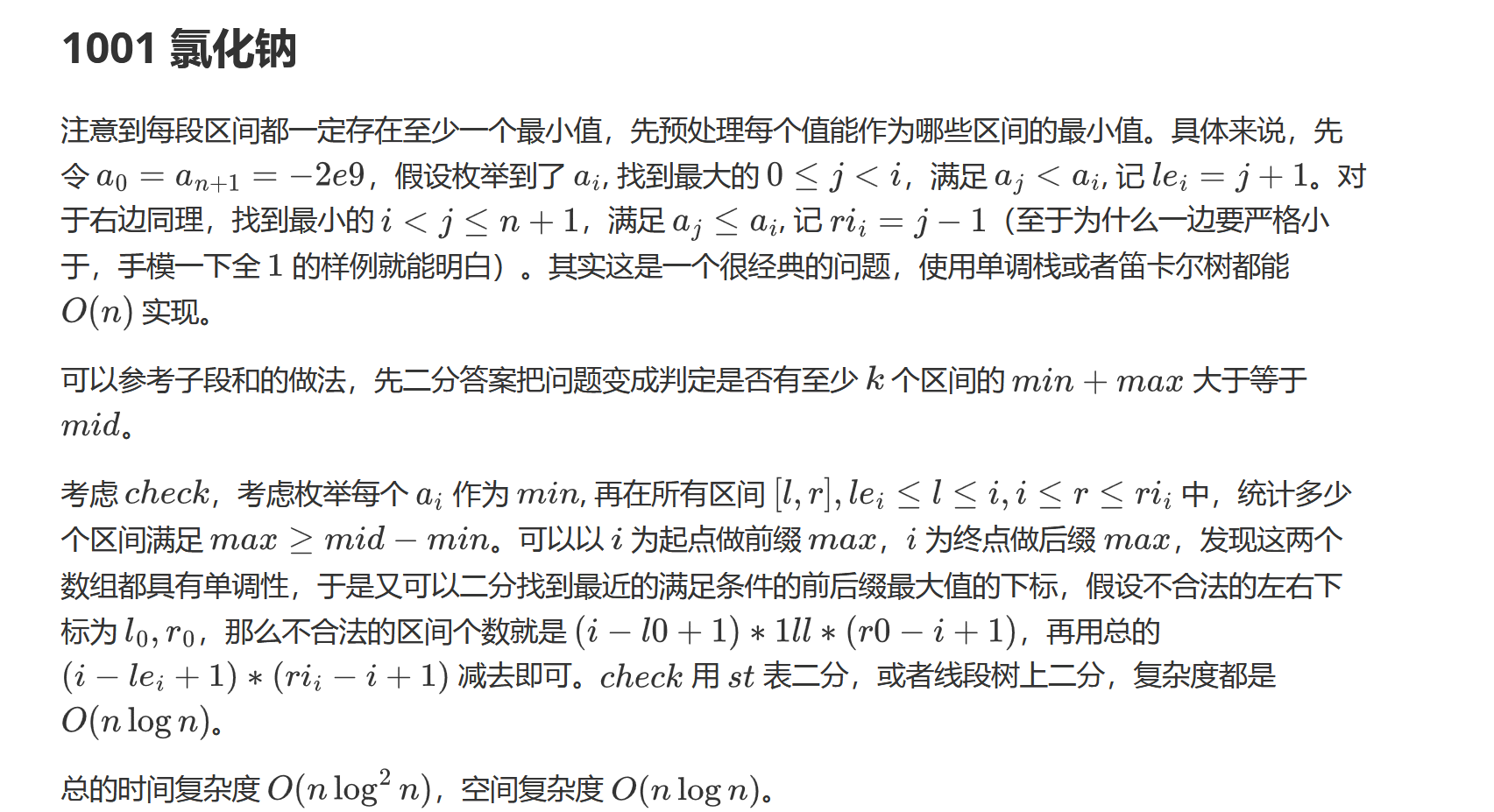
题解文件找不到了,我就贴图片吧。

更新:更快的复杂度(2026-09-26)

本节的优化思路由 ChatGPT 提供,代码据此整理。

原题解对每个位置二分左右的最大值,每次判定需要 \(O(n\log n)\)。可以把这一步改成离线扫描:固定答案 \(x\),对最小值位置 \(i\) 设阈值 \(t=x-a_i\)。不达标的区间必须完全不包含任何 \(a_j\ge t\) 的位置。

按 \(a_i\) 从大到小处理位置,阈值 \(t\) 单调递增;同时删除所有 \(a_j<t\) 的位置。用并查集合并相邻的已删除位置,就能在均摊 \(O(\alpha(n))\) 时间内找到包含 \(i\) 的已删除连续段边界,也就是左右最近的 \(a_j\ge t\) 的位置。将这两个边界限制在 \(i\) 作为最小值时的归属范围内,即可直接算出不达标区间数。

下面是完整的 C++17 实现。最小值相同的区间按“左侧严格小于、右侧小于等于”的边界规则分配给最右侧最小值位置,与原题解一致。

1
2
3
4
5
6
7
8
9
10
11
12
13
14
15
16
17
18
19
20
21
22
23
24
25
26
27
28
29
30
31
32
33
34
35
36
37
38
39
40
41
42
43
44
45
46
47
48
49
50
51
52
53
54
55
56
57
58
59
60
61
62
63
64
65
66
67
68
69
70
71
72
73
74
75
76
77
78
79
80
81
82
83
84
85
86
87
88
89
90
91
92
93
94
95
96
97
98
99
100
101
102
103
104
105
106
107
108
109
110
111
112
113
114
115
116
117
118
119
120
121
122
123
124
125
126
127
128
129
130
131
#include <bits/stdc++.h>
using namespace std;
using int64 = long long;

struct DeletedDSU {
int n;
vector<int> parent, size, left, right;
vector<char> removed;

explicit DeletedDSU(int n)
: n(n), parent(n + 1), size(n + 1, 1),
left(n + 1), right(n + 1), removed(n + 1, false) {
iota(parent.begin(), parent.end(), 0);
iota(left.begin(), left.end(), 0);
iota(right.begin(), right.end(), 0);
}

int find(int x) {
int root = x;
while (parent[root] != root) root = parent[root];
while (parent[x] != x) {
int next = parent[x];
parent[x] = root;
x = next;
}
return root;
}

void unite(int a, int b) {
a = find(a);
b = find(b);
if (a == b) return;
if (size[a] < size[b]) swap(a, b);
parent[b] = a;
size[a] += size[b];
left[a] = min(left[a], left[b]);
right[a] = max(right[a], right[b]);
}

void erase(int x) {
if (removed[x]) return;
removed[x] = true;
if (x > 1 && removed[x - 1]) unite(x, x - 1);
if (x < n && removed[x + 1]) unite(x, x + 1);
}

pair<int, int> nearestAlive(int x) {
int root = find(x); // x is removed when this is called
return {left[root] - 1, right[root] + 1};
}
};

int64 kthLargest(const vector<int>& a, int64 k) {
int n = static_cast<int>(a.size()) - 1;
vector<int> L(n + 1), R(n + 1), st;

// Previous strictly smaller element.
for (int i = 1; i <= n; ++i) {
while (!st.empty() && a[st.back()] >= a[i]) st.pop_back();
L[i] = st.empty() ? 1 : st.back() + 1;
st.push_back(i);
}

// Next smaller-or-equal element.
st.clear();
for (int i = n; i >= 1; --i) {
while (!st.empty() && a[st.back()] > a[i]) st.pop_back();
R[i] = st.empty() ? n : st.back() - 1;
st.push_back(i);
}
vector<int> order(n), removeOrder;
iota(order.begin(), order.end(), 1);
sort(order.begin(), order.end(), [&](int x, int y) {
return a[x] > a[y];
});
removeOrder = order;
reverse(removeOrder.begin(), removeOrder.end());

auto countAtLeast = [&](int64 x) {
DeletedDSU dsu(n);
int ptr = 0;
int64 count = 0;

for (int i : order) {
int64 threshold = x - a[i];
while (ptr < n && a[removeOrder[ptr]] < threshold) {
dsu.erase(removeOrder[ptr++]);
}

int64 total = 1LL * (i - L[i] + 1) * (R[i] - i + 1);
if (a[i] >= threshold) {
count += total;
continue;
}

auto [p, q] = dsu.nearestAlive(i);
int64 leftChoices = i - max(L[i], p + 1) + 1;
int64 rightChoices = min(R[i], q - 1) - i + 1;
int64 below = leftChoices * rightChoices;
count += total - below;
}
return count;
};

int64 maxA = *max_element(a.begin() + 1, a.end());
int64 low = 0, high = 2 * maxA;
while (low < high) {
int64 mid = low + (high - low + 1) / 2;
if (countAtLeast(mid) >= k) low = mid;
else high = mid - 1;
}
return low;
}

int main() {
ios::sync_with_stdio(false);
cin.tie(nullptr);

int T;
cin >> T;
while (T--) {
int n;
int64 k;
cin >> n >> k;
vector<int> a(n + 1);
for (int i = 1; i <= n; ++i) cin >> a[i];
cout << kthLargest(a, k) << '\n';
}
return 0;
}

单次判定为 \(O(n\alpha(n))\),排序和单调栈预处理为 \(O(n\log n)\);答案上界为 \(2A\) 时,总复杂度为 \(O(n\log n+n\alpha(n)\log(2A+1))\),空间复杂度为 \(O(n)\)。

赛时情况

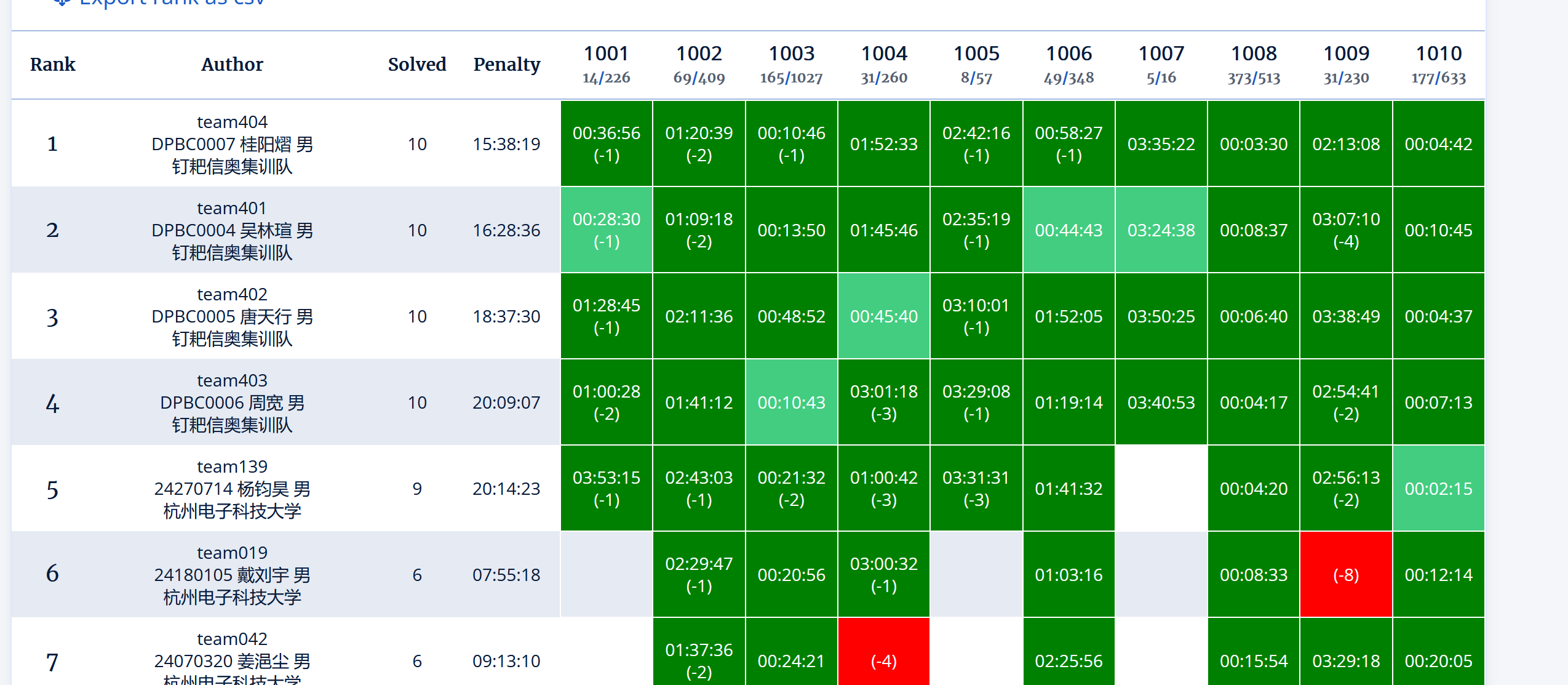
比赛时有 5 个老哥 AC 了这道题(1001),可能是因为码量比较大吧。


Nacl
https://widsnoy.top/posts/9420/
作者
widsnoy
发布于
2025年2月13日
许可协议